If you’ve spent any time around live sound, you’ve heard the debate: digital vs analog mixing. Some engineers swear by the warmth and simplicity of analog desks. Others won’t run a show without scenes, snapshots, and remote control from a tablet across the room.
After mixing dozens of shows on analog boards and digital consoles — including years of regular gigging on the XR18, time on the X32, and hands-on experience with the Wing — I’ve stopped thinking about this as an ideology debate. The right choice between digital vs analog mixers for small venues depends on your venue size, your workflow, and what you actually need to pull off a reliable show. This guide breaks that down based on real experience, not spec sheets.
As an Amazon Associate, I earn from qualifying purchases at no extra cost to you.
What Analog Mixers Do Well
Analog mixers still have genuine strengths worth acknowledging before we talk about why most small venues have moved away from them.
The biggest appeal is simplicity. Every channel has its own dedicated knobs and faders. Signal flow is completely visible — you can trace the path of audio physically across the board. There are no menus, no firmware updates, no software crashes. What you see is exactly what you get.
For someone learning gain staging and basic EQ from scratch, an analog console is an excellent teaching tool. The physical layout makes the concepts tangible in a way that menu-driven interfaces don’t always replicate. Many engineers describe analog boards as having a warm, natural character — particularly when preamps are pushed in a live environment.
A solid entry-level analog option is the Yamaha MG10XU — 10 inputs, built-in effects, and USB connectivity at a price that won’t hurt.
The limitations are real though. No scene recall. No built-in compression or effects without external hardware. No remote mixing from the room. Every show starts from scratch. For venues with multiple acts, rotating engineers, or any kind of consistent repeatability requirement, analog quickly becomes inefficient.
Why Digital Mixers Dominate Small Venues Now
Digital mixers convert incoming audio to digital, process it internally, and convert back to analog at the outputs. That architecture unlocks capabilities that simply aren’t practical in analog rigs.
Every channel gets built-in EQ, compression, gating, and effects — no external rack gear required. Scenes can be saved and recalled instantly, which means soundcheck for the second band on a multi-act bill takes minutes instead of starting over from zero. You can mix from anywhere in the room with a tablet, which is genuinely transformative for dialing in front-of-house sound from where the audience actually stands.
For small venues, choosing digital vs analog mixers comes down to this: digital means less gear, faster setup, and more consistent results night after night. Once scenes are dialed in for a regular room, even less experienced operators can run shows reliably.
The tradeoffs are real. Digital mixers have a learning curve. Menu-driven interfaces slow you down until you know them. And yes — digital systems rely on software. When something crashes, everything stops. That’s why I still keep a small analog board as a backup, even though it hasn’t come out of the case in a while.
The Mixers Worth Considering for Small Venues
Behringer XR18 — Best for Small Venues and Gigging Bands ($509)
The XR18 is my personal recommendation for most small venue situations and gigging bands. It’s an 18-input digital stagebox with built-in Wi-Fi, four FX slots, and multitrack USB recording — and it does all of that for $509.
There are no physical faders. Everything is controlled remotely via tablet using the X AIR app, which means the mixer lives on stage with short cable runs while you mix from the front of the room. For clubs, rehearsal spaces, churches, and portable band rigs, that workflow is a genuine game-changer.
The built-in multitrack recording is one of my favorite features — being able to capture every channel of a live show without an additional interface has been huge for our band. I cover that in detail in my multitrack recording guide for the XR18. For a full breakdown of everything this mixer does, see my Behringer XR18 review.
Behringer X32 Compact — Best for Venues That Want Physical Faders ($1,649)
The X32 Compact uses the same effects engine and preamp design as the XR18 but adds physical faders, more inputs, and expanded routing options. If you want the tactile feel of a traditional mixing desk combined with the power of a digital platform, the X32 Compact is the step up.
It’s a better fit for medium-sized venues, theater productions, and situations where multiple monitor mixes and fast physical adjustments matter during a live show. The X32 platform also unlocks the full effects rack — I cover that in my guide on unlocking the X32 effects rack on the XR18. For a deeper look at when the X32 platform makes sense over the XR18, see my XR18 vs X32 comparison guide.
Behringer X32 Rack — Best for Rack-Mount Installations ($1,350)
The X32 Rack gives you the full X32 processing platform in a rackmount form factor — no physical faders, controlled by tablet or a connected surface. It’s ideal for installed sound in churches, theaters, and permanent venue setups where the mixer lives in a rack and the operator works remotely.
At $1,350 it sits between the XR18 and X32 Compact on price, and offers a compelling middle ground for venues that need X32-level routing and I/O without the full console footprint.
Behringer Wing — For Complex Touring and Broadcast Workflows
The Wing pushes digital mixing further with a touchscreen interface, 48 channels, and a highly customizable layout. It’s a serious professional tool — powerful, flexible, and built for demanding applications.
For most small venues and gigging bands, it’s more console than you need. Where it earns its place is in touring productions, broadcast environments, and large-scale church installations where the routing complexity and channel count justify the investment. The Wing Rack version brings all of that in a stagebox form factor similar to the XR18.
Note: The Wing Rack is currently sold out — check availability on Amazon if you need it now.
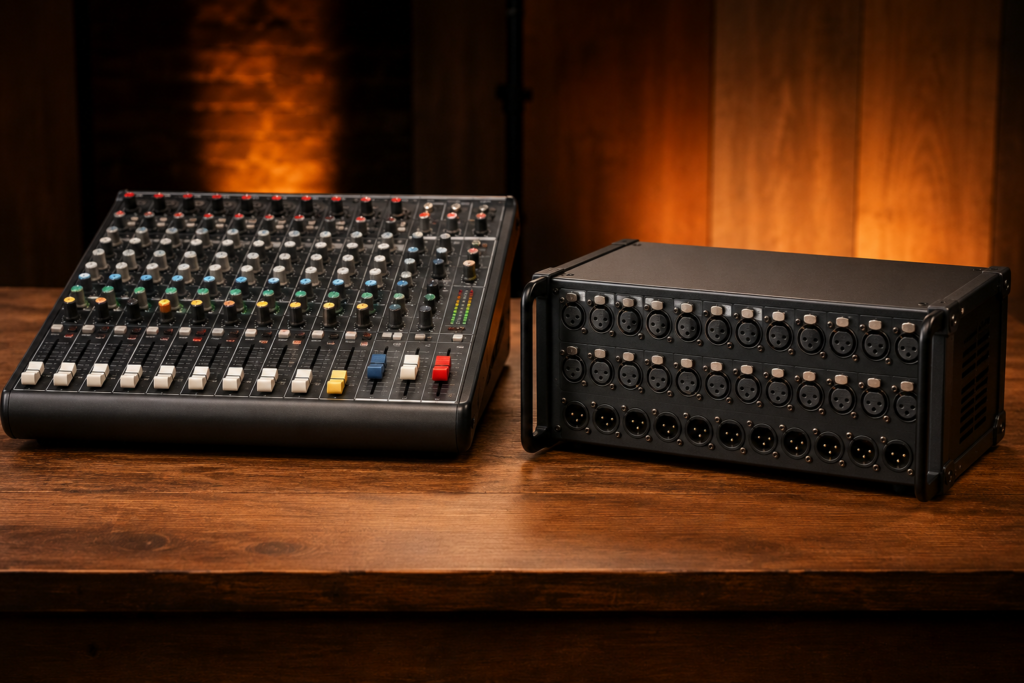
Analog vs Digital: Side-by-Side
| Feature | Analog | Digital |
|---|---|---|
| Setup speed | Slower | Faster |
| Scene recall | No | Yes |
| Built-in processing | Requires external gear | Included |
| Learning curve | Lower | Moderate |
| Portability | Larger footprint | Compact options |
| Repeatability | Manual every time | Fully recallable |
| Price (entry level) | ~$295 | ~$509 |
How Mixer Choice Affects the Rest of Your Rig
Your mixer doesn’t exist in isolation. It affects everything connected to it — microphones, monitors, and how your whole signal chain behaves on stage.
Digital mixers give you more tools for managing feedback. Built-in parametric EQ on every channel and output means you can notch problem frequencies precisely rather than reaching for an external graphic EQ. If you’re working to dial in monitor mixes without feedback, see my guide on how to stop feedback on stage with the XR18.
Mixer choice also interacts with microphone selection. The XR18’s preamps are clean and transparent, which means they’ll pass along whatever character your microphone has — good and bad. For vocal mic recommendations that pair well with digital mixers, see my best live vocal microphones guide and my SM58 vs Beta 58A comparison.
At the cable level, digital mixers don’t compensate for bad signal upstream. A quality XLR cable from the mic to the stagebox matters as much as the mixer itself. See my best XLR cables for musicians guide for what I use on every gig.
Which Mixer Is Right for You?
Choose the Yamaha MG10XU if: You’re running a simple setup, learning the basics, or need an affordable analog option for low-complexity shows.
Choose the Behringer XR18 if: You’re a gigging band or small venue that wants full digital power, remote mixing, and multitrack recording at the best price in its class. This is where most people should start.
Choose the Behringer X32 Rack if: You need X32-level processing and I/O in a permanent rack installation — church, theater, or installed venue sound.
Choose the Behringer X32 Compact if: You want physical faders, more channels, and expanded routing for medium-sized venues or productions with complex monitor mixes.
Consider the Wing if: You’re running touring-level productions, broadcast workflows, or large-scale installations where the X32 platform has hit its ceiling.
Digital vs Analog Mixers for Small Venues: Final Verdict
Analog mixers still have their place — simple setups, backup rigs, and situations where zero learning curve is the priority. But for most small venues and gigging bands in 2026, digital mixing offers more flexibility, consistency, and control with fewer compromises.
The XR18 is where I’d point most people. It’s what I use, it’s what I trust, and at $509 it delivers capabilities that would have required a full rack of outboard gear on an analog setup. If your needs grow beyond it, the X32 platform scales with you.
Frequently Asked Questions
Digital vs Analog Mixers for Small Venues: Which Is Harder to Learn?
They can seem intimidating at first because many controls live in menus or software. But once you understand the layout, digital mixers often become easier to operate — settings save and recall instantly, and you don’t rebuild your mix from scratch every show.
Do digital mixers sound better than analog?
Modern digital mixers provide clean signal paths, consistent processing, and better repeatability between shows. Analog has warmth that some engineers prefer, but for live small-venue work the practical advantages of digital outweigh the sonic differences for most applications.
Why are small venues switching to digital mixers?
Scene recall, remote mixing from tablets, built-in effects and EQ, and compact footprints. Once a venue has experienced recallable scenes for recurring acts, going back to analog is a hard sell.
Is the XR18 good for beginners?
Yes — it’s one of my top recommendations for bands getting into digital mixing. The X AIR app is intuitive, the processing is professional-grade, and the price makes it accessible. The learning curve is real but manageable, and the XR18 review covers everything you need to get started.
What’s the difference between the XR18 and X32?
The XR18 is a tablet-controlled stagebox with no physical faders. The X32 adds faders, more inputs, and expanded routing in a traditional console form factor. Full breakdown in my XR18 vs X32 comparison.