Finding the best Behringer mixer for church use is one of the most common questions in worship audio — and the answer depends entirely on your congregation size, worship team complexity, and budget. From small church plants running Sunday services on a tight budget to large worship productions with full bands, IEM monitoring, and livestream outputs — there’s a Behringer mixer built for it.
The reason is straightforward: Behringer delivers professional-level audio features at prices that make sense for ministry budgets. Their mixers run the same Midas-designed preamps found in consoles costing five times as much, and the X Air and X32 ecosystems are so widely adopted that finding tutorials, trained volunteers, and community support is easy no matter where you are.
A friend of mine plays at one of the largest churches in our area. Their audio setup cost tens of thousands of dollars. Most congregations don’t need anything close to that level — but understanding the range of what’s available helps you make the right call for your specific situation.
This guide covers every Behringer mixer worth considering for church use, from the most affordable option to professional-grade production tools — with honest recommendations based on congregation size, worship team complexity, and budget.
As an Amazon Associate I earn from qualifying purchases at no extra cost to you.
Why Churches Choose Behringer
Before diving into the specific models, it’s worth understanding why Behringer dominates church audio at this price point.
Midas preamp technology. Every mixer in this guide uses Midas-designed mic preamps. Midas is a professional audio brand whose consoles have been used in major touring productions and broadcast facilities for decades. Having that preamp quality accessible at $300-$1,700 is genuinely remarkable and is the primary reason Behringer’s church-friendly mixers sound as good as they do.
The X Air and X32 ecosystem. Behringer’s church mixers share a common ecosystem — compatible apps, compatible stage boxes, compatible workflows. A church that starts on an XR18 and grows into an X32 Rack doesn’t start over from scratch. The transition is natural and the community knowledge carries over.
Scene recall. Every Behringer digital mixer on this list supports complete scene memory — saving your entire Sunday setup as a preset that can be recalled instantly at the start of each service. For volunteer-heavy sound teams, this is one of the most valuable features a church mixer can have.
Built-in effects. Reverbs, delays, compressors, and dynamics processing are all included in every model. No outboard gear required. For a budget-conscious congregation, this saves thousands of dollars compared to building an equivalent analog rig.
Multitrack recording. Every mixer here supports USB multitrack recording — capturing every channel of a service simultaneously for broadcast, archive, or post-production. As more churches stream services online, this capability has gone from bonus feature to essential requirement.
Quick Comparison: Behringer Church Mixers
The table below shows how each option stacks up — use it as your starting point for finding the best Behringer mixer for church applications at your budget level.
| Mixer | Mic Inputs | AUX Sends | USB Recording | Price | Best For |
|---|---|---|---|---|---|
| XR16 | 8 | 4 | 16×16 | ~$300 | Small congregation, simple setup |
| XR18 | 16 | 6 | 18×18 | ~$500 | Small-medium church, IEM capable |
| X32 Rack | 16 (expandable) | 16 | 32×32 | ~$900 | Medium-large church, growing worship team |
| X32 Compact | 16 (expandable) | 16 | 32×32 | ~$1,649 | Physical faders, larger productions |
| Wing Rack | 24 (expandable) | 16 stereo | 48×48 | ~$1,799 | Large church, professional production |
1. Behringer XR16 — Best Starter Option
Best for: Small congregations under 100 people, simple worship setups, tight budgets
The Behringer XR16 is the entry point into the X Air ecosystem and a genuinely capable mixer for small church applications. At around $300, it delivers 8 Midas-designed mic preamps, 8 additional line inputs, 4 AUX sends for monitor mixes, and 16×16 USB recording in a compact 1U rack unit.
For a small congregation with a basic worship setup — a pastor’s mic, a few vocalists, an acoustic guitar, and a keys player — the XR16 covers everything comfortably. The X Air app provides the same wireless control as the XR18, letting your sound tech adjust the mix from anywhere in the sanctuary using a phone or tablet.
The 4 AUX sends support independent monitor mixes for up to four musicians, which handles most small worship team configurations. If your congregation uses in-ear monitors, the XR16 can support IEM mixes for a small group before running out of AUX sends.
Where the XR16 shows its limits is channel count. 8 mic preamps is a hard ceiling — add a full drum kit and you’re already at capacity before vocals or instruments. For congregations where the worship team might grow, the XR18 is a smarter long-term investment for just $200 more.
What the XR16 does well:
- Most affordable path into professional Behringer digital mixing
- 8 Midas mic preamps deliver quality well above the price point
- Same X Air app workflow as the XR18 — easy to upgrade later
- Compact 1U rack form factor
- Built-in Wi-Fi for wireless control from anywhere in the room
- 16×16 USB recording for service capture
Limitations to know:
- 8 mic inputs is a hard ceiling — no expansion
- 4 AUX sends limits monitor mixing for larger groups
- Fully app-based — requires tablet or laptop to operate
- No physical faders or onboard controls
The XR16 is right for your church if: You have a small, simple worship setup with 6-8 inputs, a tight budget, and a volunteer sound team willing to learn app-based mixing. It’s the right starting point for a church plant or a small congregation that wants professional digital mixing without a professional price tag.
2. Behringer XR18 — Best Value Pick
Best for: Small to medium congregations, churches running in-ear monitors, best dollar-for-dollar value
The Behringer XR18 is the sweet spot of this entire lineup — and one of the best value propositions in church audio at any price point. For around $500, you get 16 Midas-designed mic preamps, 6 AUX sends for individual monitor and IEM mixes, an 18×18 USB audio interface for multitrack recording, and the full X32 effects engine in a single 1U rack unit.
For a small to medium worship band — vocals, guitars, keys, bass, and drums — the XR18’s 16 input channels cover a typical Sunday service without compromise. The 6 AUX sends give every member of a five or six-piece worship team their own personalized monitor or IEM mix, controlled wirelessly from their phone using the free X Air app. This eliminates the need for a separate monitor desk entirely, saving both money and stage complexity.
The built-in effects engine is the same one found in Behringer’s professional X32 series. Reverbs, compressors, gates, and dynamics processing are all included — and they’re genuinely professional quality. For a congregation that can’t afford outboard gear, the XR18’s onboard processing delivers everything a worship mix requires.
Scene recall means your volunteer sound tech can walk in on Sunday morning, recall the saved service scene, and have the mixer ready to go in seconds. Every fader level, EQ setting, and routing decision from last week is preserved exactly as you left it.
The XR18 also records every channel of your service simultaneously over USB — all 16 inputs plus the stereo aux captured cleanly to a laptop running Reaper or any other DAW. For churches that livestream or archive services, this is a genuinely powerful capability at a price that’s hard to argue with.
What the XR18 does well:
- Exceptional value — professional features at an entry-level price
- 16 Midas mic preamps handle full worship band setups
- 6 AUX sends for individual IEM and monitor mixes
- Full X32 effects engine included
- 18×18 USB multitrack recording for livestream and archive
- Scene recall for consistent weekly setups
- Built-in tri-mode Wi-Fi router
- Compact 1U rack form factor
Limitations to know:
- Fully app-based — requires Wi-Fi and a tablet or laptop
- No physical faders or onboard controls
- Stereo IEM capability limited to 3 stereo mixes before AUX sends run out
- Built-in Wi-Fi works for soundcheck but Ethernet is recommended for live services
The XR18 is right for your church if: You have a small to medium worship team, want to run IEM monitors without a separate monitor desk, and are comfortable with app-based mixing. It’s the best dollar-for-dollar mixer on this list and the one I’d recommend to most congregations without hesitation.
For a complete walkthrough of the XR18’s capabilities, see our full Behringer XR18 review. And if you want to record your services, our guide to multitrack recording with the Behringer XR18 covers the complete USB setup process.
3. Behringer X32 Rack — Best Overall for Growing Churches
Best for: Medium to large congregations, established worship bands, churches with dedicated sound teams
The Behringer X32 Rack has been the church audio standard for over a decade — and it earns that reputation. For around $900, it delivers everything a medium to large worship production demands: 16 onboard Midas mic preamps expandable to 32 inputs via AES50 stage boxes, 16 AUX sends for comprehensive monitor mixing, 32×32 USB recording, and the full X32 effects suite in a compact rack unit.
The 16 AUX sends are the headline upgrade over the XR18. Where the XR18 can deliver 6 individual monitor mixes, the X32 Rack delivers 16 — enough for every musician in a large worship band to have a completely independent monitor or IEM mix with full stereo capability. For a worship team with drums, multiple guitars, keys, bass, and multiple vocalists, this flexibility makes a meaningful difference in what musicians hear on stage and how performances sound.
Expandability is what separates the X32 Rack from the XR series long-term. The AES50 ports allow you to connect digital stage boxes — place the box near the musicians and run a single Cat5 cable back to the mixer at the sound booth. This eliminates long analog snake runs across the sanctuary, cleans up your stage, and dramatically simplifies setup and teardown each week.
The X32 Rack is also the most widely supported church mixer in its class. The community of X32 users in church audio is enormous — online tutorials, trained volunteers, certified trainers, and peer support are all readily available. If you hire a new sound tech or bring on a volunteer, the odds are good they already know the X32 platform.
What the X32 Rack does well:
- 16 AUX sends for comprehensive monitor and IEM mixing
- AES50 expansion for digital stage boxes — eliminates analog snakes
- Full stereo IEM capability for every musician simultaneously
- 32×32 USB multitrack recording
- Industry-standard platform with massive community support
- Scene recall and virtual soundcheck capability
- Compatible with all X32 and Midas M32 stage boxes
Limitations to know:
- No built-in Wi-Fi — requires an external wireless router for app control
- Fully app-based — no physical faders onboard
- Larger investment than the XR series
- Learning curve steeper than the X Air app for new volunteers
The X32 Rack is right for your church if: Your worship team is growing beyond 16 inputs, you need full stereo IEM mixes for every musician, and you want a platform with AES50 expansion capability that won’t need replacing for years. It’s the safest long-term investment in this price range for a congregation that’s serious about audio quality.
For a detailed comparison of the X32 Rack against the XR16 and XR18, see our Behringer XR16 vs XR18 vs X32 Rack comparison.
4. Behringer X32 Compact — Best for Churches That Want Physical Faders
Best for: Established worship teams, sound engineers who prefer tactile control, churches with a dedicated mixing position
The Behringer X32 Compact takes everything that makes the X32 Rack exceptional and adds something the rack unit doesn’t have — a physical control surface with 17 motorized faders, dedicated channel controls, and a built-in 7-inch color display. For sound engineers and volunteers who prefer hands-on mixing over app-based control, the X32 Compact changes the workflow entirely.
The mixing power is identical to the X32 Rack. Same 16 Midas preamps, same 16 AUX sends, same 32×32 USB recording, same AES50 expansion capability. The difference is purely in how you interact with it. Instead of reaching for a tablet, your sound tech has real faders under their hands — faders that move automatically when scenes are recalled, giving physical feedback of every level change.
For churches with a dedicated sound booth, the X32 Compact sits naturally at a mixing position the way a traditional console would. Volunteers who are intimidated by fully tablet-based mixing often adapt to the X32 Compact much faster because the interface resembles what they’ve seen before. The built-in display means basic mixing tasks don’t require a connected device at all.
The X32 Compact is also a significant upgrade from an ergonomic standpoint for long service mixing. Reaching for a tablet repeatedly during a two-hour service is fatiguing in a way that reaching for physical faders is not. For sound engineers running multiple services every weekend, this matters more than most people expect.
What the X32 Compact does well:
- Physical motorized faders for tactile mixing control
- Built-in 7-inch color display — no tablet required for basic operation
- Same mixing power as the X32 Rack — 16 AUX sends, AES50 expansion
- Faster volunteer onboarding for those familiar with traditional consoles
- Scene recall with motorized faders moving automatically
- 32×32 USB multitrack recording
Limitations to know:
- Larger physical footprint than the rack units — requires dedicated space
- Significantly higher price than the X32 Rack for the same mixing capability
- Still benefits from tablet control for deep parameter editing
The X32 Compact is right for your church if: You have a dedicated sound booth, a volunteer team that benefits from physical faders, and a budget that allows for the additional investment over the X32 Rack. The tactile control surface is a genuine quality-of-life upgrade for anyone mixing multiple services every week.
5. Behringer Wing Rack — Best Professional Grade
Best for: Large congregations, professional sound engineers, broadcast and livestream productions
Note: The Wing Rack is currently in high demand with limited Amazon stock availability. Check the link above for current status — it’s worth the wait.
The Behringer Wing Rack represents the current state of the art in professional rackmount digital mixing at its price point, and nothing currently available comes close for what it delivers at approximately $1,799. This is the mixer that previously required spending $5,000-8,000, compressed into a 4U rack unit through genuinely impressive engineering.
The Wing Rack offers 48 input channels, 28 buses, 24 Midas Pro mic preamps, and a built-in 10.1-inch capacitive touchscreen — the full Wing console experience in a rackmount form factor. For a large church with an expansive worship band, multiple vocal mics, broadcast outputs, and complex routing requirements, the Wing Rack handles it all in a single unit.
The true stereo architecture is what separates the Wing Rack from the X32 platform fundamentally. Every channel, bus, and effect is processed in full stereo — richer, more spacious mixes with greater depth and dimension. For worship music that emphasizes atmosphere, this architecture makes a perceptible difference that musicians and congregation members notice.
The 16 stereo AUX buses deliver full stereo IEM mixes to every member of a large worship team simultaneously — something no other Behringer mixer at this price point can match. Add dual SD card recording for up to 64 channels and a 48×48 USB interface, and the Wing Rack covers broadcast, recording, and live sound in a single box.
For churches already running X32 stage boxes, the Wing Rack is compatible with existing AES50 infrastructure — meaning you can upgrade the mixer without replacing your entire stage setup.
What the Wing Rack does well:
- 48 channels and 28 buses for large productions
- True stereo architecture for richer, more immersive mixes
- 10.1-inch built-in touchscreen — no external device required
- Full stereo IEM mixes for every musician simultaneously
- 64-channel SD card recording plus 48×48 USB interface
- Compatible with existing X32 and Midas M32 stage boxes
- Expansion capability for Dante and Waves SoundGrid networks
Limitations to know:
- Currently limited stock on Amazon — availability fluctuates
- Steeper learning curve than the X32 platform for new users
- Wing CoPilot app is slower than X Air — Mixing Station app recommended
- Significant investment over the X32 series
The Wing Rack is right for your church if: You have a professional or semi-professional sound team, a large worship band with complex monitoring needs, broadcast or livestream requirements, and want a platform that won’t need replacing for the next decade.
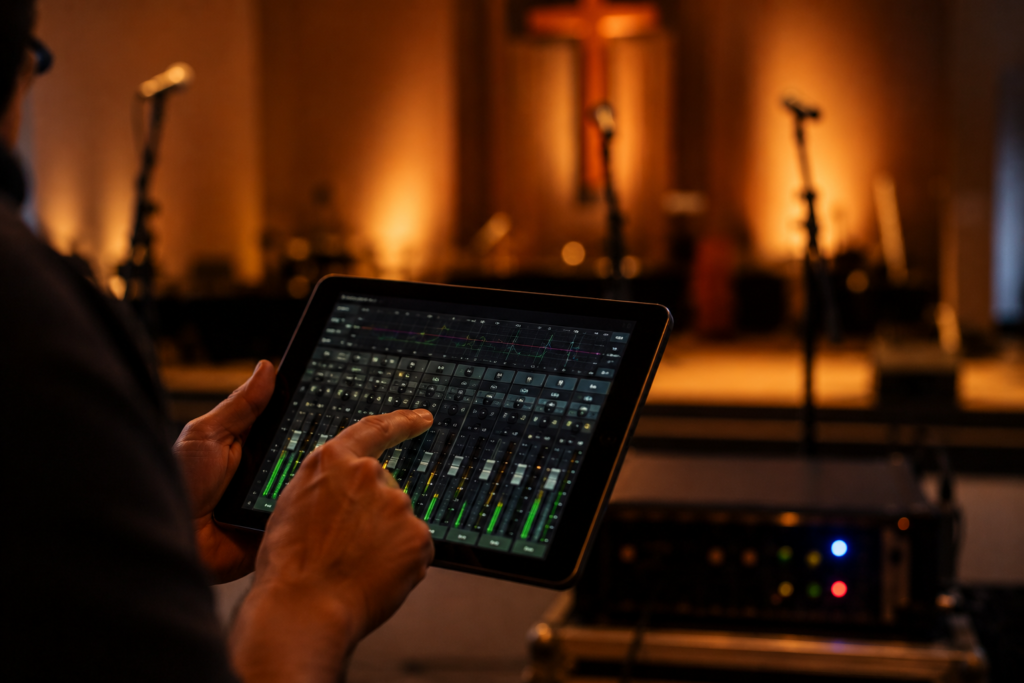
How to Choose the Right Behringer Mixer for Your Church
Start with your input count
Count every microphone and instrument your worship team uses on a typical Sunday. Add 20-30% for growth. That determines your minimum channel requirement.
- 6-8 inputs → XR16
- 10-16 inputs → XR18
- 16-24 inputs → X32 Rack or X32 Compact
- 24+ inputs → Wing Rack
Consider your monitoring setup
If your worship team uses or wants in-ear monitors, AUX send count matters significantly.
- Up to 4 mono IEM mixes → XR16
- Up to 6 mono IEM mixes → XR18
- Full stereo IEM mixes for everyone → X32 Rack, X32 Compact, or Wing Rack
For a complete guide to setting up IEM monitoring with the XR18, see our how to set up in-ear monitors for small bands guide.
Think about who runs your sound
Volunteer operators with limited experience adapt fastest to the X Air app on the XR16 and XR18 — the interface is clean and straightforward. Volunteers who prefer physical controls adapt faster to the X32 Compact. Professional engineers can handle any platform on this list.
Plan for recording and livestream
Every mixer here supports USB multitrack recording. The XR18’s 18×18 recording covers most small church needs. The X32 series and Wing Rack handle more complex broadcast setups with dedicated mix outputs and higher channel counts.
Budget honestly
The best mixer is the one your church can actually afford, learn, and maintain confidently. A well-run XR18 in the hands of a skilled volunteer produces better results than a Wing Rack nobody knows how to use.
Frequently Asked Questions
What is the best Behringer mixer for church use on
a small congregation budget?
For most small congregations, the Behringer XR18 is the best choice. At around $500, it handles a full small worship band with 16 input channels, supports IEM monitoring for every musician, and includes multitrack recording. The XR16 is the right choice if budget is the primary concern and your setup genuinely only needs 8 mic inputs.
Can Behringer mixers handle church livestreaming?
Yes. Every mixer on this list supports USB multitrack recording, allowing you to capture every channel of a service for broadcast or post-production. The X32 series and Wing Rack offer additional dedicated outputs for livestream feeds. For a complete recording setup guide, see our Behringer XR18 multitrack recording guide.
Do Behringer church mixers work with volunteers?
Yes — the X Air ecosystem is widely regarded as one of the more approachable digital mixing platforms for volunteers. The X Air app is clean and logical, and the community support for X Air and X32 is extensive. The X32 Compact adds physical faders for volunteers who prefer tactile control over app-based mixing.
What is the difference between the XR18 and the X32 Rack for church use?
The main differences are AUX send count (6 vs 16), expansion capability (XR18 has none, X32 Rack supports AES50 stage boxes), and USB recording depth (18×18 vs 32×32). For a small worship team, the XR18 covers everything needed. For a larger team needing full stereo IEM mixes and stage box connectivity, the X32 Rack is the right upgrade. See our full XR16 vs XR18 vs X32 Rack comparison for the complete breakdown.
Is the Behringer Wing Rack worth the price for churches?
For large congregations with professional sound teams and complex production requirements, yes — absolutely. The Wing Rack delivers capabilities that previously required spending $5,000-8,000 at a $1,799 price point. For smaller churches, the X32 Rack delivers everything needed at a fraction of the cost.
Do Behringer church mixers control feedback well?
Yes. Every mixer on this list includes parametric EQ on every channel and a real-time analyzer for identifying problem frequencies. With proper gain staging and EQ, feedback is manageable on any of these platforms. For a practical guide to feedback control, see our how to stop feedback on stage with the XR18 — the techniques apply across the entire Behringer lineup.
Can I upgrade from an XR18 to an X32 Rack later?
Yes — and the transition is smoother than most mixer upgrades. The X Air and X32 ecosystems share compatible workflows, and volunteers familiar with the XR18 adapt to the X32 platform quickly. Your existing microphones, cables, and stage gear all carry over without changes.